Changeover Costs Do Not Stay on the Floor: Rethinking the Economics of High-Mix Work
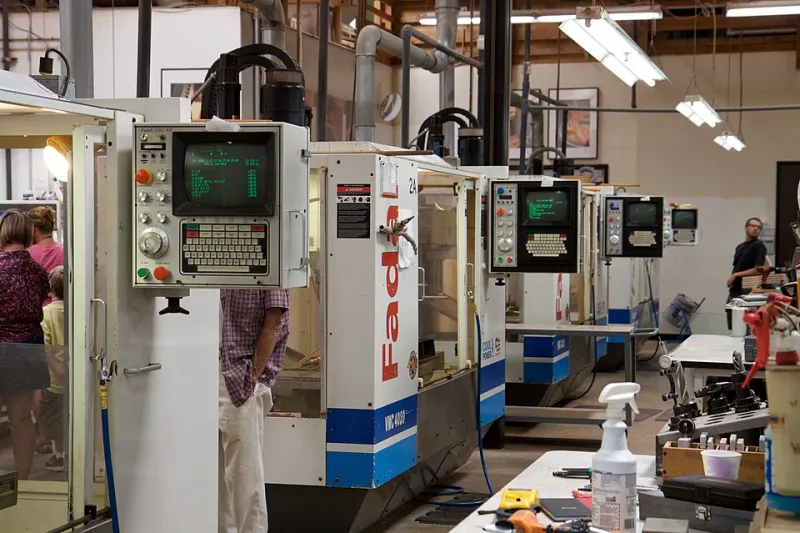
Photo: Marcin Wichary, CC BY 2.0, via Wikimedia Commons
High-mix precision manufacturing has a flattering arithmetic problem. A job can show a healthy margin in the estimating system and still consume more capacity than the business can afford. The gap usually sits between jobs, not inside them: the fixture that must be built, the machine that waits while the first article is inspected, the schedule that shifts because a low-volume order arrived with incomplete documentation. Those costs are real, but they are rarely assigned to the job that caused them.
That is the setup time tax. It is not a single line item. It is a set of costs that accumulate every time a precision shop changes from one part family, material, tolerance band, or customer requirement to another. In a low-mix operation, setup is amortized across long runs and tends to stay visible. In a high-mix operation, setup is the business model. The shops that manage it well do not eliminate changeovers; they price, plan, and engineer them deliberately.
Where the Tax Is Assessed
The first step is to see setup as more than time on the machine. A changeover can include several cost pools that are easy to miss when the focus is on spindle hours alone.
- Changeover labor and machine idle time, from the last good part of the previous job to the first good part of the next.
- Fixture design, build, proving, and storage, including the engineering time that never appears on a job traveler.
- First-article inspection, documentation review, and customer approval waits.
- Material staging, tooling changes, program proving, and scrap generated during ramp-up.
- Schedule churn: the expediting, overtime, and lost throughput caused when a setup overruns and pushes downstream work.
A shop may quote two hours of setup and spend six. It may quote one first-article inspection and consume half a shift waiting for a coordinate measuring machine, a quality signature, or a customer response. Those differences do not disappear because the estimating model averages them into burden. They appear as late deliveries, overtime, and jobs that quietly fail to earn their keep.
Why Standard Costing Misses It
Most cost models are built for repetition. They absorb setup into a machine-hour rate or a labor burden and spread it across all work. That approach is convenient, but it can subsidize the wrong jobs. A stable, high-volume runner may carry setup costs that belong to a complex, low-volume job with tight tolerances and extensive documentation. The result is a portfolio that looks balanced on paper while the difficult work erodes margin and consumes capacity.
Quoting amplifies the problem. If the estimating desk uses a standard setup allowance for every job, then the shop is effectively offering a discount to every customer whose work requires unusual fixturing, unfamiliar material, or a first-article cycle that takes longer than the norm. The discount is invisible at the moment of sale and obvious only in the quarterly review.
Capacity planning has a similar blind spot. A schedule built on run time alone assumes that machines move from job to job without friction. In a high-mix environment, setup hours can represent a meaningful share of available machine time. If those hours are not in the plan, the plan is not a plan. It is a wish list with due dates.
Measuring the Real Setup Load
A useful measurement starts with a clear definition. For each job, define setup as the interval from the last good part of the prior job to the first good part of the new job, including fixture proving and first-article approval. Then capture the time in categories: machine idle, operator labor, engineering support, inspection wait, and rework. The categories matter because they point to different fixes.
Shops should track setup hours per job, per part family, and per machine. They should also track setup frequency. A job with a four-hour setup that runs once a quarter is a different economic animal from a job with a two-hour setup that runs every week. A simple setup tax rate can be calculated as setup cost divided by job revenue, or setup hours divided by run hours. Neither ratio is perfect, but both make the invisible visible.
The comparison between quoted setup and actual setup is especially valuable. If actual setup consistently exceeds the quote, the estimating model is not measuring the business; it is measuring an older version of the business. That variance should feed back into pricing, process engineering, and customer selection.
Replanning Without Chasing Unrealistic Lot Sizes
The wrong response to setup cost is to force every job into a larger lot. That can reduce changeover frequency while creating inventory, obsolescence, and cash-flow problems. High-mix customers often need small lots precisely because their own demand is variable. The goal is not to pretend that low-volume work is high-volume work. The goal is to charge for the real cost and then reduce the cost where it is technically and economically sensible.
Several practical moves help. Setup-adjusted quoting assigns a setup band based on part family, fixturing complexity, and inspection requirements. Modular fixturing and standardized tooling packages reduce proving time. External setup moves preparation off the machine. Scheduling by family, rather than by arrival date alone, can group similar work without inflating lot sizes beyond customer demand. A documented first-article plan reduces waiting and rework.
None of these moves requires a capital project. Most require discipline and a willingness to treat setup as production data rather than shop-floor folklore.
A Practical Cadence
A high-mix shop can manage the setup tax with a simple cadence. Weekly, review setup variances on jobs that missed their quoted hours. Monthly, review setup hours by family and machine, and adjust capacity assumptions. Quarterly, review pricing bands and customer mix. The point is not to punish the floor for overruns. The point is to learn where the estimating model and the production system disagree.
At Sohar Industries SPC, the operating view is straightforward: a changeover is not dead time between value-creating work. It is work. It consumes labor, machine capacity, engineering attention, and schedule flexibility. Once it is measured and quoted honestly, high-mix manufacturing can remain profitable without asking customers to buy lot sizes they do not need.