The Vanishing Workforce: Protecting Institutional Knowledge Before It Walks Out the Door
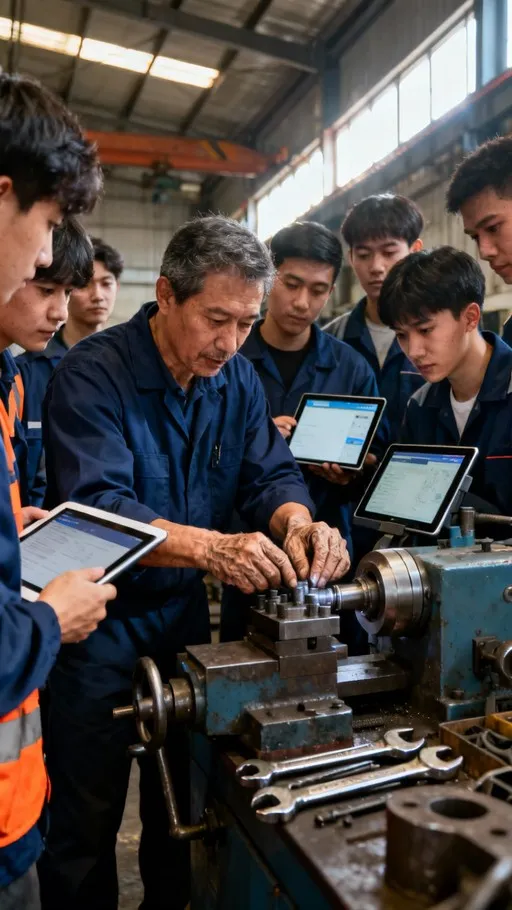
Photo: experienced machinist mentoring young worker manufacturing training, via images.stockcake.com
There is a particular kind of knowledge that does not live in a procedure manual or a CAD file. It lives in the hands of a machinist who has run the same part family for twenty-three years, in the judgment of a process engineer who knows exactly how a particular alloy behaves on a cold Monday morning, in the intuition of a setup technician who can hear when a spindle bearing is starting to wear before any sensor flags it. That knowledge is irreplaceable—and across American manufacturing, it is retiring at an accelerating pace.
The demographic picture is stark. The Manufacturing Institute estimates that the US manufacturing sector will need to fill approximately 3.8 million jobs by 2033, with a significant portion of that demand driven by retirements rather than growth. The average age of a skilled manufacturing worker in the United States now exceeds 44, and in certain precision trades, the concentration of experience among workers within five to ten years of retirement is even more pronounced. Companies that have not already begun addressing this reality are operating with a ticking clock.
What Institutional Knowledge Actually Means on the Shop Floor
The phrase "institutional knowledge" can sound abstract, but its practical consequences are concrete and costly. When an experienced CNC programmer retires, the shop may lose not only their technical skill but also their understanding of which toolpaths have historically caused chatter on a specific machine, which customer drawings have hidden ambiguities that require clarification before setup, and which material lots from a particular supplier run slightly differently than the certification suggests.
None of that information is written down. It was never formally documented because it accumulated gradually, informally, through years of problem-solving. The person who holds it may not even recognize it as knowledge worth capturing—it feels, to them, like common sense. To a newer employee encountering the same problems for the first time, it is anything but.
The operational consequences of losing this expertise manifest in predictable ways: longer setup times, higher scrap rates on complex parts, more frequent quality escapes, and a gradual erosion of the process consistency that distinguishes a high-performing shop from a mediocre one. These costs are real, but they tend to appear gradually and are rarely attributed directly to knowledge loss—which makes the problem easier to ignore until it becomes severe.
The Generational Transfer Problem
The challenge is not simply that experienced workers are retiring. It is that the pipeline of incoming talent is insufficient to absorb the knowledge transfer even when organizations make genuine efforts to facilitate it. Apprenticeship programs that once provided structured pathways into skilled trades have atrophied over decades. Community college manufacturing programs, where they exist, often lack the equipment and industry connectivity to fully bridge the gap between classroom training and shop-floor competency.
The result is a widening experience gap. A manufacturer might hire a technically capable young machinist with solid foundational training, but that individual will require years of guided experience before approaching the judgment level of the veteran they are nominally replacing. If the veteran retires before that transfer is complete, a portion of the accumulated expertise is simply lost.
Several manufacturers who have navigated this challenge successfully share a common insight: the transfer process cannot be left to happen organically. It must be designed, resourced, and managed with the same intentionality applied to any other operational priority.
Strategies That Work: Capturing What Cannot Be Written Down
The most effective knowledge-retention programs recognize that tacit expertise—the kind that resists documentation—requires different capture strategies than explicit procedural knowledge.
Structured shadowing and mentorship programs pair experienced workers with designated successors well before the retirement timeline becomes urgent. The key distinction between effective and ineffective versions of this approach is specificity. Vague mentorship arrangements produce limited results. Programs that define specific knowledge domains to be transferred, establish milestones, and create accountability for both parties produce measurable outcomes.
Video documentation of complex setups and processes has become increasingly practical as smartphone and tablet technology has improved. A five-minute video of an experienced machinist explaining the non-obvious aspects of a difficult setup—narrated in their own words, capturing their reasoning rather than just their actions—can preserve context that a written procedure never could. Several manufacturers have built internal libraries of hundreds of such recordings, organized by part family and process type.
Process failure mode libraries represent another underutilized tool. When experienced workers encounter and resolve a process problem, documenting not just the solution but the diagnostic reasoning that led to it creates a resource that retains some of the expert's problem-solving logic for future use.
Cross-training rotations serve a dual purpose: they build broader competency among younger workers and they create structured opportunities for knowledge transfer that might not otherwise occur. A machinist who spends three months working alongside the shop's most experienced grinder will absorb far more than they would from any formal training program.
The Role of Technology in Knowledge Preservation
Digital tools are increasingly capable of supporting knowledge retention, though they work best as complements to human transfer processes rather than substitutes for them. Advanced process monitoring systems that capture detailed data on cutting parameters, tool wear patterns, and cycle time variations can build an empirical record of process behavior over time—preserving, in data form, some of what previously existed only in an experienced worker's memory.
AI-assisted documentation tools that can transcribe, organize, and make searchable large volumes of spoken or written process knowledge are beginning to appear in forward-looking manufacturing environments. While still maturing, these tools suggest a future in which the cost of capturing institutional knowledge is significantly lower than it is today.
Enterprise resource planning and manufacturing execution systems, when configured to capture process notes and quality observations at the point of production, can also serve as knowledge repositories—provided the organizational culture supports consistent data entry, which is not always a given.
Building a Culture That Values Knowledge Transfer
Technology and process design matter, but the single most important factor in successful knowledge retention is organizational culture. In shops where knowledge transfer is treated as a priority by leadership, where experienced workers are recognized and compensated for their mentorship contributions, and where younger workers are encouraged to ask questions and document what they learn, retention programs take hold. In shops where knowledge transfer is a stated priority but an unfunded one, they do not.
This requires a candid conversation at the leadership level about what institutional knowledge is genuinely worth. The manufacturers who have built the most effective retention programs tend to be those who experienced a painful knowledge loss event—a critical retirement with insufficient succession planning, a quality problem that could only be solved by tracking down a retired employee by phone—and resolved never to be in that position again.
For US manufacturers competing in an environment where operational consistency and process reliability are genuine differentiators, the expertise residing in their most experienced workforce is a strategic asset. Protecting that asset before it retires is not a human resources concern. It is a business continuity imperative—and one that Sohar Industries SPC believes deserves the same rigorous attention as any other dimension of operational excellence.