Unplanned Downtime Is Bleeding Your Operation Dry — Here Is What the Data Says
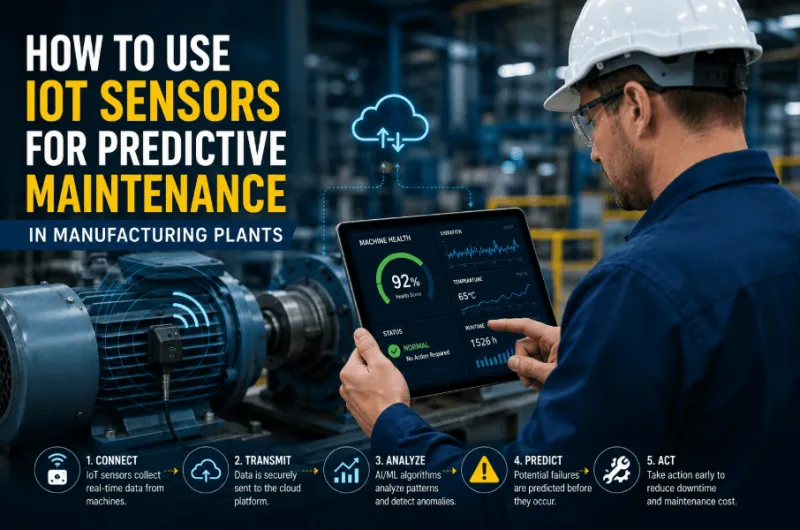
Photo: industrial predictive maintenance sensor equipment manufacturing facility, via mail.oxmaint.com
There is a moment every plant manager dreads: a critical piece of equipment goes silent mid-shift, and the cascade begins. Idle workers, stalled production lines, emergency procurement calls, and the slow-burning arithmetic of lost revenue accumulating by the hour. For US manufacturers competing in an environment defined by tight margins and demanding delivery schedules, that moment is not just an operational inconvenience — it is a direct threat to profitability.
According to research from Aberdeen Group, unplanned downtime costs industrial companies an average of $260,000 per hour across all sectors. In high-throughput environments such as automotive stamping, aerospace component fabrication, or precision CNC machining, that figure can climb considerably higher. The aggregate toll across US manufacturing is estimated at $50 billion annually — a number that has focused executive attention on a discipline once considered the domain of maintenance technicians: predictive maintenance.
The Difference Between Reacting and Anticipating
For decades, the dominant maintenance philosophy in American manufacturing fell into one of two camps. Reactive maintenance — fix it when it breaks — minimized upfront investment but exposed operations to the full financial impact of unplanned failures. Preventive maintenance introduced scheduled intervals for inspection and part replacement, reducing some failures but often resulting in the unnecessary replacement of components still well within their service life.
Predictive maintenance (PdM) represents a fundamental departure from both approaches. Rather than responding to failure or adhering to arbitrary time-based schedules, PdM uses continuous condition monitoring to assess the actual health of equipment in real time. Vibration analysis, thermal imaging, oil particle counts, acoustic emission sensors, and power consumption tracking are among the data streams feeding machine learning models that can identify anomalous patterns weeks or months before a failure event occurs.
The operational result is maintenance that happens precisely when it is needed — and not a moment before.
Quantifying the Financial Upside
The business case for predictive maintenance is increasingly well-documented. A 2023 report from Deloitte found that PdM programs typically reduce equipment breakdowns by 70 percent, lower maintenance costs by 25 to 30 percent, and eliminate unnecessary preventive maintenance activities by up to 40 percent. When these gains are mapped against baseline operational costs, the return on investment becomes compelling.
Consider a mid-sized precision parts manufacturer running three eight-hour shifts across a facility with 40 CNC machining centers. If that facility experiences an average of four unplanned shutdowns per year — each lasting six hours and affecting ten machines — the direct production loss alone, calculated at conservative throughput values, can exceed $1.2 million annually. Layer in emergency labor premiums, expedited parts sourcing, and the reputational cost of delayed customer deliveries, and the true figure rises further still.
A PdM deployment in that same facility — integrating vibration sensors on spindle assemblies, thermal monitoring on servo drives, and a centralized analytics dashboard — might carry an implementation cost of $300,000 to $500,000 depending on existing infrastructure. Industry benchmarks suggest a payback period of 12 to 18 months, with sustained annual savings thereafter.
Real-World Implementation: What the Leaders Are Doing
Across US manufacturing sectors, early adopters of predictive maintenance are reporting measurable operational improvements. A Tier 1 automotive supplier in the Midwest integrated IIoT sensors across its stamping press lines and reported a 62 percent reduction in unplanned downtime within the first year of deployment. A contract manufacturer specializing in aerospace structural components used acoustic emission monitoring to detect bearing wear in its milling centers, preventing a failure that engineers estimated would have caused $800,000 in damage to a high-value fixture.
What these implementations share is a phased approach. Rather than attempting a facility-wide digital transformation in a single capital cycle, successful programs typically begin with the highest-criticality assets — the machines whose failure creates the most severe downstream disruption. Baseline condition data is established, alert thresholds are calibrated, and maintenance teams are trained to interpret predictive signals rather than simply respond to alarm states.
Integration with enterprise resource planning (ERP) and computerized maintenance management systems (CMMS) is the next layer, enabling maintenance activities to be automatically scheduled, parts pre-positioned, and labor allocated before a failure window opens. At that stage, the maintenance function shifts from a cost center to a strategic operational asset.
Addressing the Organizational Barriers
Despite the compelling economics, PdM adoption across US manufacturing remains uneven. Smaller and mid-market facilities often cite capital constraints, workforce skill gaps, and uncertainty about technology selection as primary barriers. These concerns are legitimate, but they are not insurmountable.
Cloud-based analytics platforms have substantially reduced the infrastructure investment required to process sensor data at scale. Managed service models — where a technology partner assumes responsibility for sensor deployment, data interpretation, and maintenance recommendations — lower the internal expertise threshold. And federal incentive programs, including those under the Manufacturing USA network and various Department of Energy industrial efficiency initiatives, have made funding available to qualifying manufacturers pursuing smart manufacturing upgrades.
The workforce dimension deserves particular attention. Predictive maintenance does not eliminate the need for skilled technicians — it elevates their role. Maintenance professionals who learn to interpret condition monitoring data become significantly more valuable to their organizations, making PdM adoption an opportunity for workforce development as much as a capital investment.
Building the Business Case Internally
For industrial decision-makers preparing to advocate for predictive maintenance investment within their organizations, the most persuasive arguments are grounded in facility-specific data rather than industry averages. Documenting the actual cost of the last three unplanned failures — including direct repair costs, lost production, overtime, and any customer penalty clauses triggered — typically produces a baseline that justifies further analysis.
From that foundation, a phased pilot program targeting two or three critical assets can generate the operational evidence needed to support broader deployment. Pilot results, measured against pre-implementation downtime records, provide the internal proof of concept that finance teams and executive sponsors require.
The manufacturers who are protecting their production economics most effectively today are not simply investing in technology — they are building a maintenance philosophy that treats equipment health as a measurable, manageable business variable. In an industry where fractions of efficiency determine competitive position, that philosophical shift may be among the most consequential investments a facility can make.