Custom Tooling's Hidden Price Tag: When Specialized Solutions Quietly Erode Your Margins
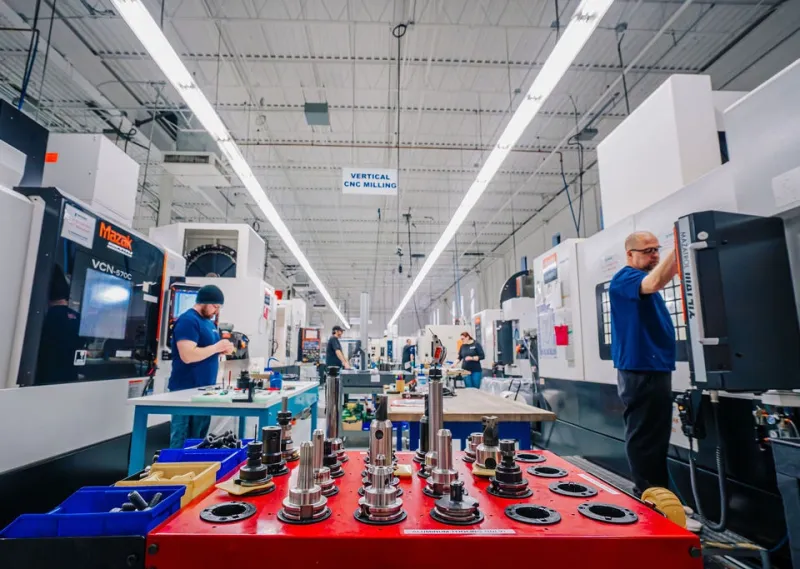
Photo: industrial custom tooling manufacturing precision machining workshop, via innoventtech.com
The justification almost always sounds reasonable in the conference room. A specialized job arrives, the existing tooling inventory cannot accommodate it, and an engineer proposes a custom solution. The upfront number looks manageable relative to the contract value, the timeline seems workable, and the project moves forward. What rarely makes it onto that initial spreadsheet is everything that happens afterward.
For US manufacturers operating in competitive, margin-sensitive environments, custom tooling decisions represent one of the most consequential—and least scrutinized—categories of capital expenditure. The acquisition cost is visible. The total cost of ownership is not.
The Anatomy of a Custom Tooling Investment
To understand where value erodes, it is useful to map the full lifecycle of a typical custom tooling investment. Acquisition is only the first chapter.
Once a custom tool enters service, it requires dedicated maintenance protocols that standard tooling rarely demands. Replacement components may need to be fabricated rather than sourced from a distributor, adding lead time and cost each time wear or damage occurs. If the original tooling engineer leaves the organization—a scenario that has become increasingly common in today's labor market—institutional knowledge about that tool's quirks, tolerances, and failure modes can disappear with them.
Beyond maintenance, there is the question of application flexibility. Standard tooling can typically be redeployed across product lines as demand shifts. Custom tooling, by definition, cannot. When the job it was designed for ends, or when design specifications change mid-contract, that investment becomes a sunk cost with limited recovery value.
A manufacturer producing precision components for the aerospace sector recently faced exactly this scenario. A multi-year contract justified a significant custom fixture investment. Eighteen months in, the customer revised the component geometry. The existing custom tooling could not be adapted. A new investment was required, and the original fixture was scrapped at a fraction of its acquisition cost. The contract remained profitable, but margins contracted sharply in ways the original bid had not anticipated.
Where the True Cost Accumulates
Research consistently shows that manufacturers underestimate total cost of ownership for custom tooling by a substantial margin. The commonly overlooked cost categories include:
Lead time dependency. When custom tooling fails or wears beyond acceptable tolerances, production does not wait gracefully. Rush fabrication of replacement components carries significant premiums, and the downstream cost of delayed shipments—including expediting fees, customer penalties, and reputational damage—can dwarf the tooling cost itself.
Calibration and qualification burden. Custom tools frequently require more intensive qualification processes than standard alternatives. Each calibration cycle consumes engineering hours that could otherwise be allocated to value-generating work. Over a multi-year tool life, this accumulates into a material cost that rarely appears in initial justifications.
Storage and inventory overhead. Custom tooling must be stored, catalogued, and managed. For manufacturers operating in facilities where floor space carries real economic weight, the physical footprint of an expanding custom tooling inventory represents a genuine cost. Unlike standard tooling, custom pieces cannot be returned to a distributor or sold on the secondary market when they are no longer needed.
Supplier concentration risk. Many custom tools are fabricated by a single supplier who understands the specification. If that supplier exits the market, raises prices, or experiences capacity constraints, the manufacturer has limited alternatives. This dependency is rarely stress-tested during the initial procurement decision.
The Decision Framework That Changes the Conversation
The question is not whether custom tooling is ever justified. It clearly is—in scenarios where no standard solution exists, where production volumes are sufficient to amortize the investment across a meaningful run, and where the geometry or material requirements genuinely cannot be addressed through standardized alternatives.
The more productive question is whether custom tooling is being evaluated with the rigor the decision deserves.
A sound decision framework should require answers to several questions before any custom tooling investment is approved:
-
Has a genuine standardization audit been conducted? Many manufacturers are surprised to discover that a modified standard tool—or a combination of standard tools—can achieve the required result at significantly lower total cost. Engineering teams under schedule pressure frequently default to custom solutions without exhausting standard alternatives.
-
What is the projected production volume, and does it support the investment? Custom tooling economics improve substantially with volume. A tool that makes financial sense at 50,000 annual cycles may be financially indefensible at 5,000. The breakeven analysis should include all lifecycle costs, not just acquisition.
-
What is the obsolescence risk? If the application is tied to a single customer, a single product design, or a technology that is evolving rapidly, the probability that the tooling will be stranded before it is fully amortized is higher than most initial analyses acknowledge.
-
What is the recovery value if the application ends early? Custom tools typically have minimal secondary market value. The investment should be evaluated as though full recovery is unlikely, because in many cases it is.
-
Is the maintenance and support infrastructure in place? Custom tooling without a clearly defined maintenance protocol and a qualified supplier capable of fabricating replacement components is a latent liability. This infrastructure should be confirmed before acquisition, not after.
When Custom Tooling Earns Its Place
None of this argues against custom tooling categorically. There are applications where the investment is not only justified but strategically essential. High-volume production of proprietary geometries, applications where standard tooling cannot achieve required tolerances, and situations where a custom solution creates a genuine competitive differentiator in quality or throughput—these represent legitimate cases for custom investment.
The manufacturers who manage these decisions well share a common discipline: they treat custom tooling as a capital allocation decision with full financial rigor, not as a technical problem to be solved by the engineering team in isolation. Finance, operations, and procurement are part of the conversation from the outset, and the decision is made with a complete picture of lifecycle cost rather than acquisition cost alone.
Protecting Margins Through Smarter Tool Selection
For US manufacturers facing persistent margin pressure, input cost volatility, and increasing customer demands for responsiveness, the discipline of tooling economics deserves more attention than it typically receives. The companies that have built systematic approaches to this decision—clear criteria for when custom solutions are warranted, rigorous total cost modeling, and regular reviews of the existing custom tooling inventory—consistently report better outcomes than those that evaluate each decision in isolation.
The goal is not to avoid custom tooling. The goal is to invest in it with clear eyes, full information, and a financial framework that accounts for everything the acquisition price does not.