Precision at What Price? The Case for Smarter Tolerance Specification in Modern Manufacturing
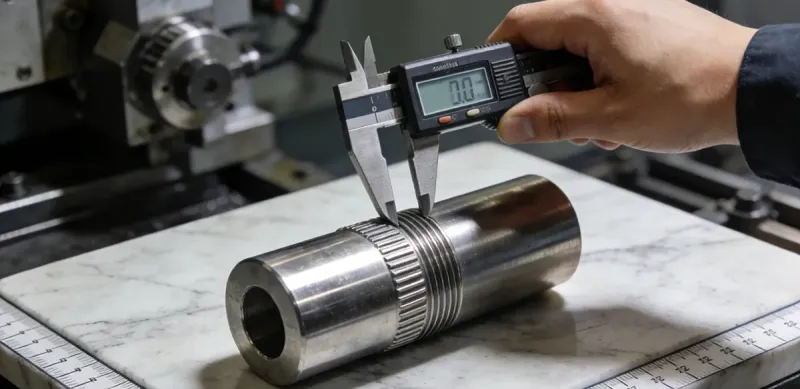
Photo: precision machining tolerance measurement manufacturing quality control, via www.sincere-machining.com
In manufacturing, tighter is frequently assumed to be better. A component specified to ±0.001 inches must surely outperform one held to ±0.005 inches, the reasoning goes. That assumption, while intuitive, can be financially ruinous when applied without discipline. Across American manufacturing floors, the reflexive pursuit of extreme precision—regardless of functional necessity—is quietly eroding profitability in ways that rarely appear on a single line item.
The reality is that tolerances are not free. Every increment of tightening carries a cost, and that cost compounds across tooling, cycle time, inspection, scrap, and rework. When those costs exceed the value the precision actually delivers to the end customer, a manufacturer has not built a better product. It has simply built a more expensive one.
The Compounding Economics of Over-Specification
To understand why unnecessary precision is so damaging, it helps to trace how tolerance requirements propagate through a production system. A single over-specified dimension on a machined component can force a shift from conventional milling to grinding, add multiple inspection steps, reduce tool life, lower acceptable feed rates, and increase the probability that a finished part is rejected at final inspection. Each of these consequences has a dollar figure attached to it.
Industry studies have consistently shown that the cost to achieve a given tolerance does not scale linearly. Moving from a ±0.010-inch tolerance to ±0.001-inch tolerance on a turned steel shaft, for example, can increase unit cost by 40 to 70 percent depending on material, geometry, and equipment. If the assembly that shaft sits in can function perfectly well at the looser specification, that additional expenditure delivers zero value to the customer—and zero return to the manufacturer.
Scrap rates compound the problem further. Tighter tolerances reduce the statistical window within which a part can be accepted. Even on well-maintained, well-calibrated equipment, normal process variation will push a higher percentage of parts outside specification when the specification itself leaves little room for deviation. The result is a higher scrap rate, more rework, and longer lead times—all of which carry real costs that standard quoting models often underestimate.
A Case Study in Profitable Relaxation
Consider a mid-sized precision components manufacturer in the Midwest that was producing hydraulic manifold blocks for industrial equipment. The original engineering drawings specified flatness tolerances on mating surfaces that had been carried forward from a previous design generation without re-evaluation. Those tolerances required surface grinding on every part—an operation that added significant time and cost per unit.
When a cross-functional team reviewed the functional requirements of the assembly, they found that the sealing system used elastomeric O-rings capable of compensating for surface variation well beyond what the drawing required. The tighter flatness tolerance was not protecting seal integrity; it was a legacy specification that had never been challenged.
After conducting controlled testing and validating the relaxed specification against actual sealing performance, the manufacturer revised the drawing. Surface grinding was eliminated for the majority of parts, replaced by a milled finish that met the revised tolerance. Unit cost dropped by approximately 22 percent. Scrap rates fell. Throughput on that cell increased. The product performed identically in the field.
This outcome is not unusual. It is, however, frustratingly uncommon—because most organizations lack a systematic process for questioning existing tolerance structures.
Where Precision Genuinely Earns Its Cost
None of this is an argument against precision. There are absolutely applications where tight tolerances are non-negotiable and where the cost of achieving them is fully justified by the functional, safety, or performance requirements of the end product. Aerospace bearing seats, medical implant interfaces, and high-pressure valve seats are examples where dimensional control at the sub-thousandth level protects lives and ensures reliability. In those contexts, the economics of precision are sound.
The discipline lies in distinguishing those critical dimensions from the many others on a typical drawing that carry tight tolerances for historical, aesthetic, or organizational-inertia reasons rather than functional ones. A structured approach to tolerance analysis—one that links each specified dimension to a specific functional requirement—can make that distinction visible and defensible.
Geometric Dimensioning and Tolerancing (GD&T), when applied thoughtfully rather than mechanically, provides a framework for this kind of analysis. It encourages engineers to specify only what the part actually needs to do, rather than defaulting to uniform tight tolerances across all features. Companies that invest in GD&T literacy among their engineering and manufacturing teams consistently report better alignment between specification cost and functional value.
Building a Tolerance Review Process That Protects Margins
For manufacturers looking to reclaim margin lost to over-specification, the starting point is not a wholesale revision of drawing standards. It is a targeted review of high-cost, high-scrap components—the parts that consistently challenge the shop floor and appear repeatedly in rework logs.
A practical approach involves three steps. First, identify the components with the highest per-unit cost relative to their complexity. Second, map each critical tolerance on those components to a specific functional requirement, asking what failure mode the tolerance is preventing. Third, where no clear functional justification exists, initiate a controlled validation study to determine whether a relaxed specification can be adopted without compromising performance.
Engineering, manufacturing, and quality must collaborate on this process. Tolerance decisions made in isolation—whether by engineers who never see the shop floor or by production teams who lack access to functional performance data—tend to produce suboptimal outcomes in both directions.
The Strategic Advantage of Knowing When Not to Be Precise
In a competitive manufacturing environment, the ability to allocate precision resources intelligently is a genuine differentiator. A manufacturer that directs its tightest tolerances, most capable equipment, and most rigorous inspection toward the dimensions that truly matter—while relaxing specifications elsewhere—will consistently outperform competitors who treat all dimensions as equally critical.
This is not about cutting corners. It is about understanding the relationship between specification, cost, and value with enough clarity to make deliberate decisions rather than defaulting to convention. For US manufacturers under ongoing pressure to maintain competitive pricing without sacrificing quality, that clarity may be one of the most valuable capabilities they can develop.
At Sohar Industries SPC, our approach to precision manufacturing is grounded in exactly this kind of functional thinking—applying rigorous dimensional control where it delivers measurable value, and engineering intelligently everywhere else.