Predictive Maintenance Programs: A Step-by-Step ROI Framework for US Manufacturing Operations
Photo: Syced, CC0, via Wikimedia Commons
Maintenance strategy is rarely the most glamorous conversation in a manufacturing operation. It competes for budget against capital equipment, workforce development, and technology upgrades — and it tends to win attention only when something breaks. That reactive dynamic is precisely the problem.
For US manufacturers operating in an environment of tightening margins, increasing equipment complexity, and persistent skilled labor shortages, the maintenance model is not a peripheral operational detail. It is a direct driver of profitability, uptime, and asset longevity. The data supporting a shift from reactive repair toward predictive maintenance is substantial — and the ROI framework for making that case internally is more accessible than most operations leaders realize.
This guide walks through the financial comparison, the key variables, and a practical evaluation structure that any manufacturing facility can use to assess its current position.
Understanding the Three Maintenance Models
Before quantifying ROI, it is useful to define the landscape clearly. Manufacturing facilities typically operate under one of three maintenance philosophies:
1. Reactive Maintenance (Run-to-Failure) Equipment is operated until it fails, at which point repairs are initiated. No systematic monitoring or scheduled intervention occurs. This approach has low upfront cost but carries the highest exposure to unplanned downtime, emergency repair premiums, and secondary damage.
2. Preventive Maintenance (Time-Based) Equipment is serviced on fixed schedules — monthly, quarterly, or by operating hours — regardless of actual condition. This reduces catastrophic failures but often results in over-maintenance (replacing components that still have significant useful life) and under-maintenance (missing condition-specific degradation between scheduled intervals).
3. Predictive Maintenance (Condition-Based) Equipment is continuously or periodically monitored using sensor data, vibration analysis, thermal imaging, oil analysis, and similar diagnostic tools. Maintenance is performed when data indicates that intervention is warranted — not before, and not after failure. This model maximizes component life, minimizes unplanned downtime, and concentrates labor where it is actually needed.
The Cost of Staying Reactive
Reactive maintenance feels inexpensive right up until it is not. The deceptive economics of run-to-failure strategies stem from the fact that routine operations appear cost-free — until a failure event reveals the full exposure.
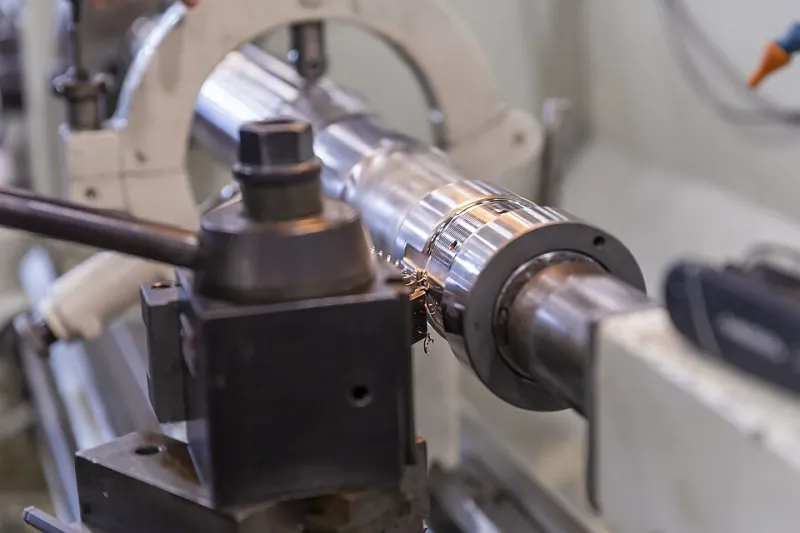
Consider a mid-sized machining operation running a CNC machining center at the core of a production cell. Under a reactive model, there is no scheduled monitoring of spindle bearing condition. When the bearing fails — often with little warning — the consequences typically include:
- Unplanned downtime: Industry benchmarks place the cost of unplanned downtime in precision machining environments at $5,000 to $15,000 per hour when downstream production impact is included.
- Emergency repair premium: After-hours labor, expedited parts sourcing, and specialized technician dispatch routinely add 40% to 60% above standard repair costs.
- Secondary damage: A failed spindle bearing rarely fails cleanly. Spindle damage, tooling loss, and workpiece scrap are common secondary costs.
- Schedule disruption: Orders that were in-process must be rescheduled, potentially triggering client penalties or expedited recovery costs.
A single unplanned failure event on a critical machine can generate $50,000 to $200,000 in direct and indirect costs. When that machine is part of a tightly sequenced production environment, the multiplier effect on downstream operations can double or triple that exposure.
What Predictive Maintenance Actually Costs
The investment profile for a predictive maintenance program varies by facility size, equipment complexity, and the depth of monitoring implemented. A practical breakdown for a mid-scale US manufacturing operation looks as follows:
Technology investment:
- Vibration monitoring sensors for rotating equipment: $500–$2,500 per asset
- Thermal imaging camera (shared across facility): $3,000–$8,000
- Oil analysis program (outsourced): $150–$400 per sample, per machine per quarter
- Industrial IoT platform for data aggregation and alerting: $10,000–$50,000 annually depending on scale
Labor and training:
- Initial program setup and baseline data collection: 40–80 hours of technician time
- Ongoing monitoring and analysis: typically 10–20% reduction in total maintenance labor hours over 24 months as unplanned events decrease
For a facility with 20 critical assets, total first-year program investment typically falls in the range of $75,000 to $150,000. That figure must be evaluated against the failure cost profile of the assets being monitored.
The ROI Calculation: A Practical Framework
The following five-step framework provides a structured basis for evaluating predictive maintenance ROI in any manufacturing context:
Step 1: Identify and rank critical assets Not every piece of equipment warrants predictive monitoring. Prioritize assets based on failure consequence severity, replacement lead time, production centrality, and historical failure frequency. Focus initial investment where failure impact is highest.
Step 2: Establish baseline failure cost For each critical asset, calculate the average annual cost of reactive maintenance over the past three to five years. Include direct repair costs, downtime cost, secondary damage, and scheduling disruption. If historical data is incomplete, industry benchmarks by equipment type are available from SMRP (the Society for Maintenance and Reliability Professionals).
Step 3: Model failure avoidance value Research consistently indicates that predictive maintenance programs reduce unplanned downtime by 30% to 50% and extend asset service life by 20% to 40%. Apply conservative versions of these ranges to your baseline failure cost to estimate annual avoidance value.
Step 4: Calculate net annual benefit Subtract the annualized program cost (technology, labor, analysis services) from the failure avoidance value. For most facilities with well-selected critical asset lists, net annual benefit turns positive within 12 to 18 months of program launch.
Step 5: Factor in asset lifecycle extension This is the variable most frequently omitted from maintenance ROI analyses. Extending the service life of a $500,000 machining center by two to three years defers capital expenditure that would otherwise appear in the budget. Discounted to present value, lifecycle extension is often the single largest component of predictive maintenance ROI.
Common Implementation Barriers — and How to Address Them
"We don't have the internal expertise." Predictive maintenance programs do not require in-house data scientists. Outsourced condition monitoring services, equipment OEM programs, and managed IoT platforms have made program entry accessible for facilities of all sizes. Start with one asset class and build institutional knowledge progressively.
"Our equipment is too old to instrument." Retrofit sensor solutions exist for the majority of rotating and reciprocating equipment in service across US manufacturing. Age is rarely a genuine barrier; it is more commonly a proxy for unfamiliarity with available options.
"We can't justify the upfront cost." The upfront cost argument collapses when failure cost baselines are honestly documented. In most cases, a single avoided catastrophic failure event recovers the full first-year program investment. The ROI case is not speculative — it is historical.
Connecting Maintenance Strategy to Manufacturing Quality
For precision manufacturers, the relationship between equipment condition and output quality is direct and measurable. A machining center operating with early-stage spindle bearing wear will produce dimensional variation before it produces a detectable failure. That variation may be within tolerance today and outside it next week — with no visible change in equipment behavior to prompt intervention.
Predictive maintenance is therefore not only a cost-control strategy. In precision manufacturing environments, it is a quality assurance mechanism. The same monitoring infrastructure that prevents catastrophic downtime also provides early warning of the subtle condition changes that precede quality degradation.
At Sohar Industries SPC, the integration of equipment health monitoring into our production environment reflects a commitment to delivering consistent, specification-compliant results across every production run. Clients who depend on tight tolerances and reliable delivery schedules benefit directly from the operational stability that a mature predictive maintenance program supports.
The Bottom Line
The financial case for predictive maintenance is not complicated. It requires honest accounting of what reactive failures actually cost, a realistic assessment of what monitoring technology now costs to implement, and a willingness to treat maintenance as an investment rather than an expense.
Manufacturers who make that shift consistently report improved uptime, lower total maintenance spend, extended capital asset life, and more predictable production performance. Those outcomes are not incidental — they are the compounding returns of treating equipment health as a managed variable rather than an unknown.
The question is not whether predictive maintenance delivers ROI. The question is how long a facility can afford to defer the calculation.