Quality at What Cost? Rethinking the Full Economics of Precision in Your Manufacturing Operation
Photo: Raimond Spekking, CC BY-SA 4.0, via Wikimedia Commons
Precision is not free. That statement may seem self-evident, yet the accounting systems at most US manufacturing facilities treat it as though it were. Defect rates appear on dashboards. First-pass yield figures circulate in weekly operations reviews. Inspection rejection logs are maintained with care. What rarely surfaces in those same reviews is the cumulative cost of how precision is being pursued — the labor hours consumed by verification, the scrap generated by tolerances set tighter than the application demands, and the extended lead times that result from multi-stage inspection protocols that were never re-evaluated after the original product specification was written.
The gap between what quality metrics measure and what precision actually costs is where margin quietly disappears.
What Standard Quality Metrics Actually Capture
Conventional quality measurement in manufacturing tends to concentrate on outcomes: the percentage of parts that pass inspection, the volume of returns from customers, and the frequency of production stoppages attributed to quality failures. These are legitimate indicators, and they serve a real purpose. The problem is that they function as lagging indicators — they confirm that something went wrong after the cost has already been incurred.
More critically, they say nothing about the cost of preventing those failures. A facility with a 99.2 percent first-pass yield may appear to be performing well. But if achieving that yield requires three separate CMM inspections per batch, a dedicated team of quality technicians on each shift, and a scrap rate driven not by process instability but by tolerance specifications that exceed what the end application requires, the economics of that yield figure deserve serious scrutiny.
The metric looks healthy. The operation may not be.
The Over-Specification Problem
One of the most consistent sources of hidden cost in precision manufacturing is tolerance over-specification. Engineers, understandably, tend toward conservatism when defining dimensional requirements. The instinct is sound in principle — tighter tolerances reduce variation and, in safety-critical applications, that reduction is non-negotiable. But in a significant portion of manufactured components, the specified tolerance is tighter than the functional requirement demands.
When a tolerance is tighter than necessary, several cost consequences follow in sequence. Cycle times increase because the machining or forming process must operate more slowly and carefully. Scrap rates rise because more parts fall outside the narrower acceptance window, even when the process is well-controlled. Inspection time per part grows because tighter tolerances require more precise measurement equipment and more careful technique. And rework rates climb because parts that would have been acceptable under a more appropriate specification are instead pulled from the line.
None of these costs appear in the quality metric. They appear in labor costs, material costs, and throughput figures — categories that are rarely traced back to tolerance decisions.
Inspection Labor as an Unexamined Cost Center
Inspection is frequently treated as a fixed operational requirement rather than as a variable cost that should be calibrated to actual risk. In practice, many US manufacturers apply the same inspection intensity to commodity components as they do to precision-critical assemblies, because the inspection protocol was designed for the most demanding part in a product family and was never differentiated.
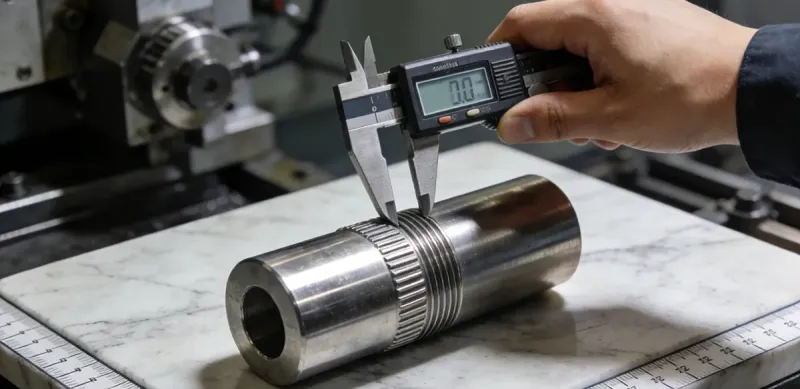
The labor cost embedded in that approach is substantial. A skilled metrology technician represents a significant hourly investment. When that technician is spending time verifying dimensions on a bracket or housing where a dimensional deviation of a few thousandths of an inch has no functional consequence, the return on that labor is essentially zero. It is a cost that exists to satisfy an internal process requirement rather than to protect product integrity.
Risk-stratified inspection — in which inspection intensity is proportional to the functional consequence of variation — is not a new concept, but it remains underutilized in mid-market US manufacturing. Implementing it requires a structured review of part families and their actual application requirements, which represents an upfront investment. The return on that investment, however, is measurable and frequently significant.
A Framework for Evaluating Precision ROI
The central question that manufacturing operations should be asking is not "How precise are we?" but rather "Where does additional precision create value, and where does it simply create cost?"
Addressing that question systematically requires four steps.
Step one: Map the cost of precision by part family. For each major product or component category, calculate the total cost attributable to quality assurance: inspection labor, scrap and rework, extended cycle times from conservative machining parameters, and any premium paid for tighter-tolerance raw material. This exercise frequently produces figures that surprise operations leadership.
Step two: Validate tolerance requirements against functional specifications. Engage engineering in a structured review of whether current tolerances reflect actual application requirements or historical conservatism. In many cases, tolerances were established years or decades ago and have not been revisited as materials, processes, and customer requirements evolved.
Step three: Quantify the cost of failure at each tolerance level. For components where tighter tolerances are genuinely required, calculate what a dimensional failure would cost — in warranty claims, customer relationship damage, or safety consequences. This figure establishes the economic ceiling for precision investment. Spending more to prevent a failure than the failure itself would cost is a straightforward value destruction exercise.
Step four: Establish differentiated quality protocols. Once the value of precision is understood at the component level, inspection and process control protocols can be calibrated accordingly. High-consequence components receive intensive verification. Lower-consequence components receive proportionally lighter oversight, freeing capacity and reducing cost without increasing risk.
Where Precision Investment Generates Real Return
None of the above is an argument against precision. It is an argument for precision applied where it matters. In applications involving tight-clearance assemblies, high-cycle fatigue environments, pressure-containing components, or safety-critical systems, dimensional control is directly tied to product performance and liability exposure. In those contexts, the investment in precision manufacturing capability — in equipment, in process control, in verification — generates clear and defensible return.
The manufacturers who capture the most value from precision capability are those who understand exactly which components and applications belong in that category and concentrate their resources accordingly. They do not apply the same standard everywhere. They apply the right standard to the right part.
That discipline — the ability to distinguish where precision is an investment from where it is an overhead — is what separates manufacturing operations that are genuinely profitable from those that are merely technically accomplished.
At Sohar Industries SPC, precision is not a blanket standard. It is a calibrated commitment — applied with the rigor that demanding applications require and the operational intelligence that sustainable manufacturing demands.